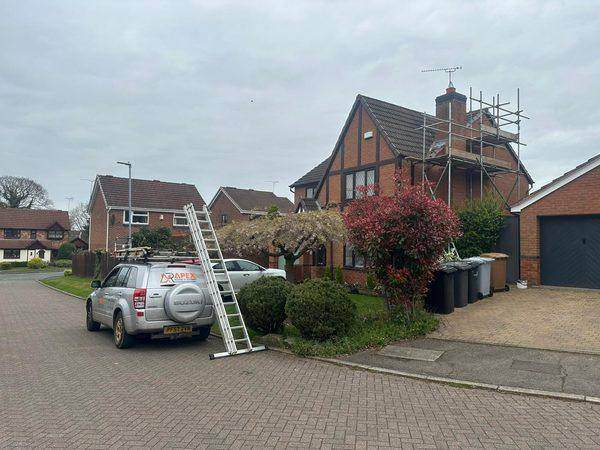
A detached house in Crewe where the bitumen felt under the tiles had torn and perished. We stripped the covering back, laid new breathable membrane and treated battens, and reinstated the tiles.
The felt is the part of a roof nobody sees until something goes wrong with it. Tiles shed most of the water, but wind-driven rain gets past them, and what catches it and runs it back out to the gutter is the membrane underneath. On this detached house in Crewe that membrane had reached the end of its life.
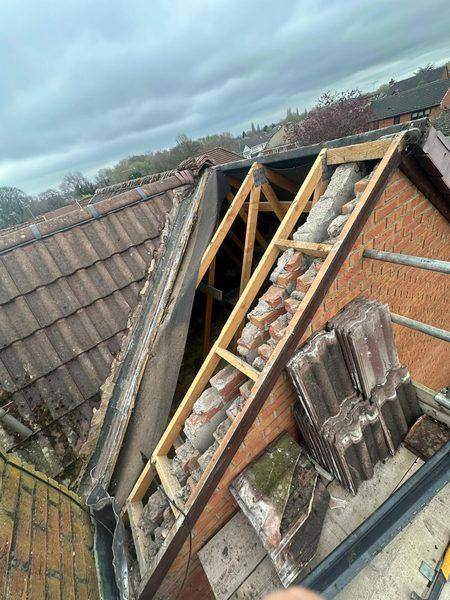
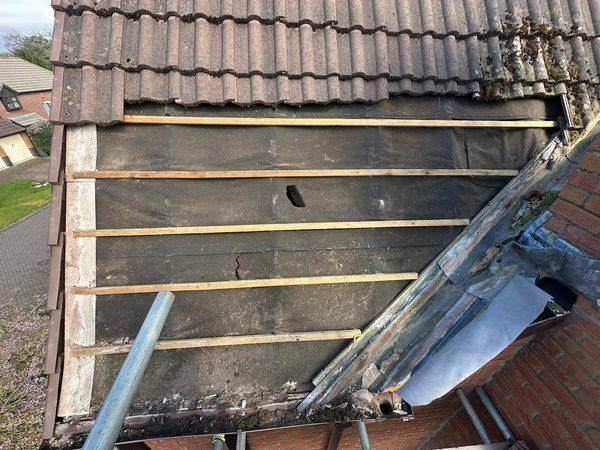
Scaffold went up along the gable and around to the chimney side, and the tiles came off in sections. What was underneath was old bitumen felt, brittle with age, sagging between the rafters and holed through in more than one place. Felt of that sort goes hard, then splits, and once it has split there is nothing between wind-driven rain and the plasterboard. This is the point at which patching stops being worth anyone's money, which is the usual reason people call a roofer in Crewe about their underlay.
Tiles came off course by course and were stacked on the slope rather than dropped, because most of them were perfectly good concrete tiles with plenty left in them. Anything cracked or broken went in the waste pile. The old battens came off with the felt, and with the covering gone we could see the roof timbers properly and check them over before anything new went back on.
Along the brick wall at the edge of the section the old bedding had broken up and there was loose rubble to clear away. That all came off and went down to the skip. It is worth the time: new battens fixed over a bed of old debris never sit flat, and a batten that does not sit flat throws the whole tile course out of line.
Breathable membrane went on first, laid in horizontal runs from the eaves up, each run lapped over the one below it so water can only ever travel outwards and downwards. Breathable is the difference worth knowing about — the old bitumen kind traps moisture in the roof space, while a modern membrane lets vapour out while keeping water on the outside.
Treated battens went over the membrane, gauged and fixed to the rafters so the tile courses came out even, then the tiles went back on. The ones we had set aside went back where they came from and the broken ones were made up with matching replacements. Finished, it looks exactly like it did before, which is the point — the change is entirely underneath.
Torn felt rarely announces itself. You get a damp patch in a bedroom ceiling after a storm that dries out again, then nothing for months, then another. If you can get into the loft with a torch on a wet day and see daylight or dark staining on the timbers, the underlay is usually the answer. Slipping tiles are another sign, because battens rot at the same rate as the felt above them.
We do whole-roof and part-roof work of this sort across south Cheshire — our roofing page sets out what that involves, and there is a similar re-batten and re-felt in Macclesfield if you want to see another. Get in touch and we will come and have a proper look before quoting anything.
Tell us what the roof is doing and roughly where you are. We will come and look, and you get a written price before anything starts.