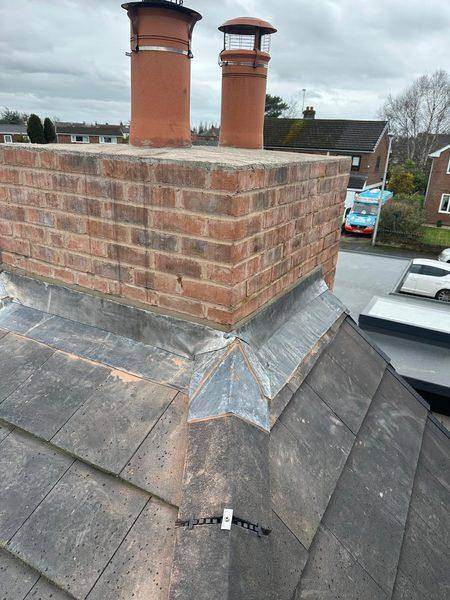
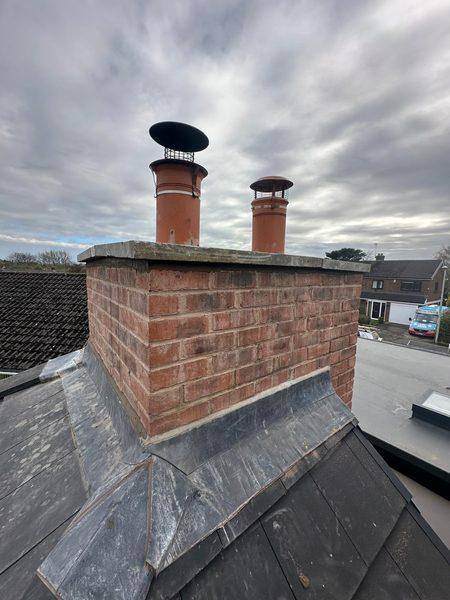
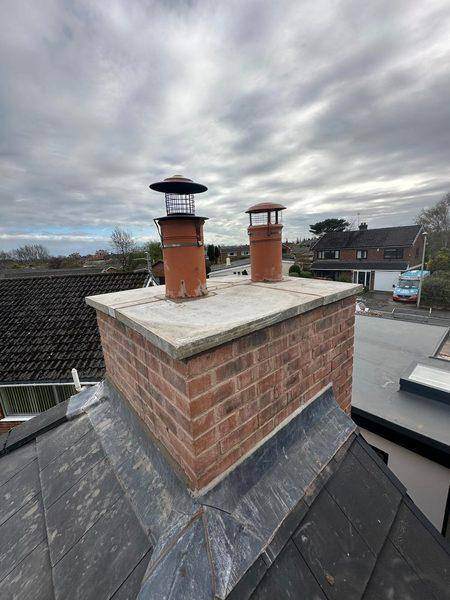
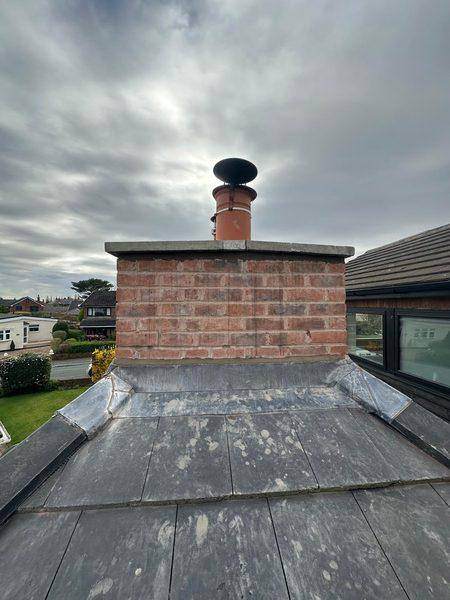
A red brick stack in Macclesfield given the full treatment: new lead flashing dressed in around the base, every joint repointed, a new capping on top and two new pots fitted.
A chimney has to do two jobs at once. It has to stand up, and it has to keep rain out of a hole running straight down through the middle of the house. When the pointing goes soft and the lead at the base gives up, it stops doing either of them well, and the damp shows up in a bedroom rather than on the roof.
This red brick stack in Macclesfield sits where the slope meets a flat roof section at the back of the house, so it takes weather on every face and has a long run of flashing round it. Rather than patch one part of it we did the lot from the roof line up: new lead at the base, the brickwork repointed through, a new capping across the top and new pots set in. It is the sort of chimney work in Macclesfield that is worth doing in one go, because getting back up to a stack twice costs more than doing it once properly.
The flashing is the joint between two things that move differently — a brick stack and a tiled slope — and it is where most chimney leaks start. New lead went in all the way round: an apron across the front face, soakers and stepped lengths up the sides where the stack passes through the slope, and a lead back gutter behind it to carry water away rather than let it sit against the brick.
You can see the finished leadwork in the photographs, dressed down tight over the tile courses and turned into the brickwork above. Dressing lead properly is slow — it has to be worked to the shape of the tiles underneath so there is no gap for wind to drive water into, and it has to be left room to expand rather than pinned flat.
With the lead in, the stack itself was repointed. The old joints were raked back to sound mortar and refilled with fresh, course by course, front and back and both sides. Soft mortar is not only a leak route; it is what lets a stack start to lean, because every joint is carrying the weight of the brick above it.
A new capping was cast across the top, sitting slightly proud of the brickwork so rain runs off the edge and drops clear rather than tracking back down the face. Two new pots were set into it, the taller one finished with a rain cap and a guard, the shorter one with a cowl. That keeps rain, leaves and birds out of the flue while still letting it breathe. We went over the whole stack again at the end before taking the gear down.
From the ground you can often see enough. Look for joints that have gone back behind the face of the brick, a crown or capping that is cracked, pots that sit at an angle, and grey lead that has gone white and lifted away from the tiles. Inside, a tide mark on the chimney breast that darkens after heavy rain usually means water is getting in above.
Our chimney repairs page covers what else we take on, from single pots to stacks that need taking down and rebuilding, and there is a flaunching repair in Warrington that shows a smaller version of this job. If you want yours looked at, drop us a line for a free quote, no obligation.
Tell us what the roof is doing and roughly where you are. We will come and look, and you get a written price before anything starts.