The old red clay ridge and hip tiles on this Warrington roof were sitting in mortar that had crumbled away. They came off and new grey ridge tiles went back on a mechanically clamped dry system.
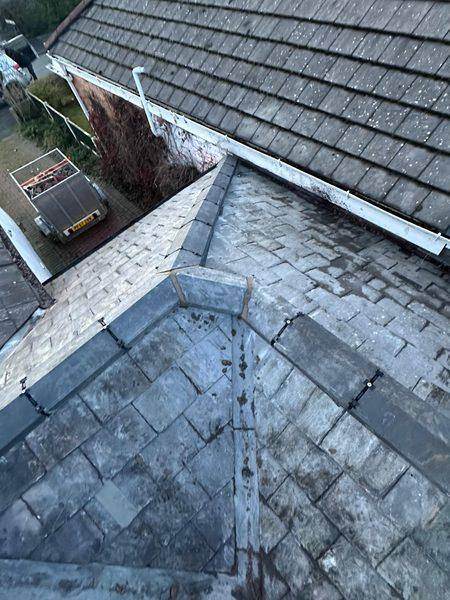
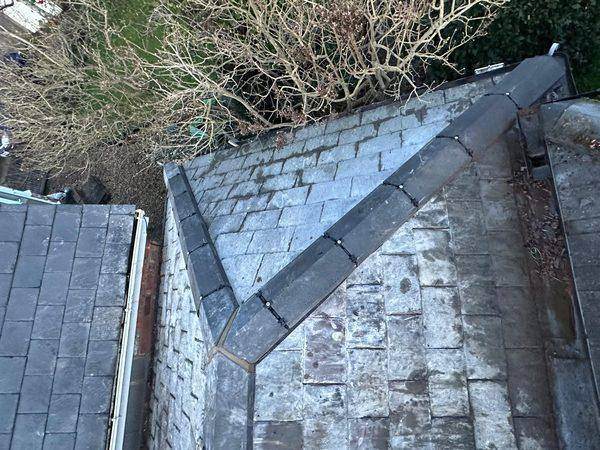
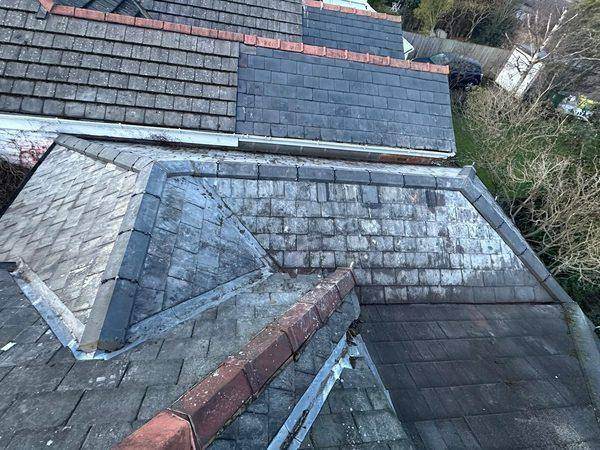
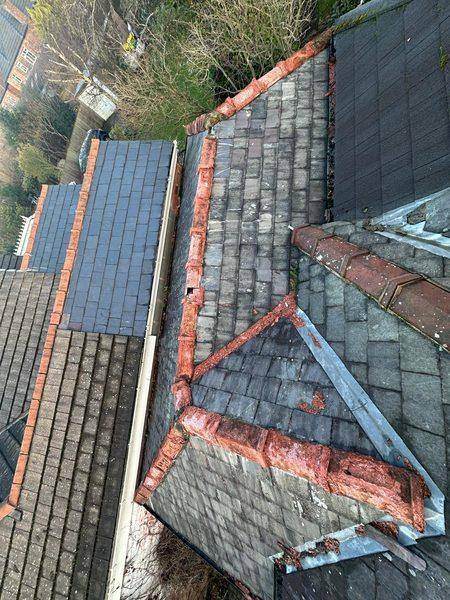
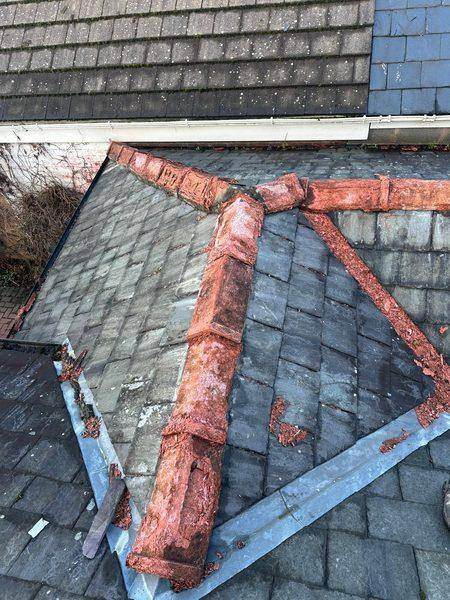
The before photographs on this Warrington job tell the story on their own. The red clay ridge and hip tiles had been bedded on mortar that had lost its strength completely — it was pink, powdery and breaking away in lumps, with the debris scattered down the slope where it had dropped out of the joints.
A hipped roof makes the problem worse than a plain ridge does, because there are three separate lines of capping meeting at the top and every one of them relies on that same bedding. Once it goes, the tiles are held by very little, and on a windy night a loose hip tile has a long way to fall.
The clay tiles were taken off one at a time and the old bedding chipped away until the line underneath was clean. Loose mortar has to be got right back to a firm edge, and the spoil swept off the roof rather than brushed into the gutter, which is where it usually ends up.
With the capping away, the top course of tiles and the line of the hips could be looked at properly. That is the moment to find anything a covered ridge has been hiding — a slipped top course, a gap at the mitre, daylight where there should not be any.
New ridge tiles went back on a dry fixing system. Instead of being buried in mortar, each one is clamped down by its own bracket, which you can see in the finished photographs as the small dark fixings spaced at regular intervals along the ridge and down both hips. A roll runs underneath to close the gap and keep wind-driven rain, birds and insects out while still letting the roof breathe at the top.
The grey ridge was chosen to sit with the colour of the roof rather than against it, which is why the finished lines look quieter than the red clay they replaced. In one photograph you can see older red capping still running along the roofs beyond, which is a fair comparison of the two finishes side by side. More of this work is on our dry ridge and verge page.
Mortar is rigid and a roof is not. Every day the covering warms, expands and cools again, and the bedding either moves with it or cracks. It cracks. Water gets into the crack, frost opens it wider, and a few winters later the joint is open enough to rock a tile by hand. Re-bedding in fresh mortar restores it for a while — there is a re-bedding job in Warrington here for comparison — but the same clock starts running again the day it is finished.
A clamped ridge takes that problem away because there is nothing rigid to crack. If your ridge line is shedding mortar, looks uneven from the pavement or has tiles that move, see our dry ridge and verge work in Warrington or ask us for a free quote.
Tell us what the roof is doing and roughly where you are. We will come and look, and you get a written price before anything starts.