Both slopes of a Warrington gable end given screw-fixed dry verge caps and a matching apex cap, closing the tile edge over the new white bargeboards without any mortar.
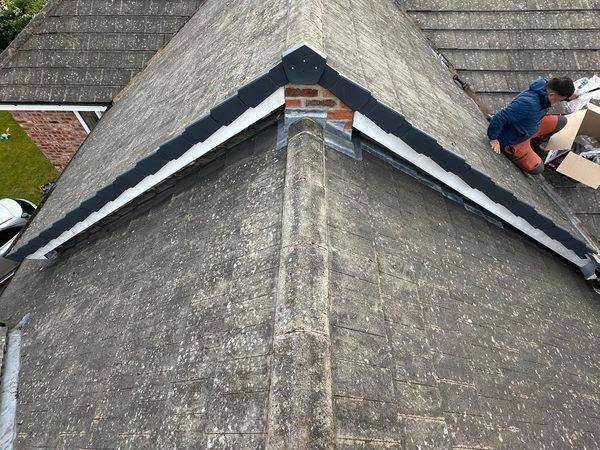
This one is a gable end on a red brick house in Warrington, tiled in grey concrete interlocking tiles that have picked up a good deal of pale lichen over the years. The roofline underneath had already been done in white UPVC, with bargeboard, soffit and black half-round gutter, and it was the tile edge above it that still needed sorting.
A verge is where the tiling stops at the gable and overhangs the wall. Traditionally that edge is pointed up in cement, and cement at an exposed edge is on borrowed time: it cracks, it comes away in lengths, and after that the wind is free to lift the end tiles and there is an open gap for birds and insects to get in behind them. Dry verge caps replace that edge with interlocking units that are screwed down instead.
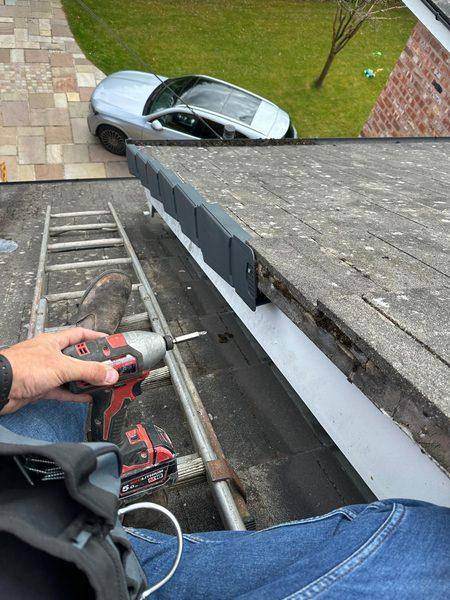
The units start at the eaves and work up, each one lapping over the one below so water runs down the face of them and off the end of the roof. Each cap sits over the end tile and is fixed with a screw straight down into the batten underneath. The close-up photograph catches that: the driver in hand, the fixed run of caps behind, and ahead of it the bare tile edge with the batten ends still showing, waiting to be covered.
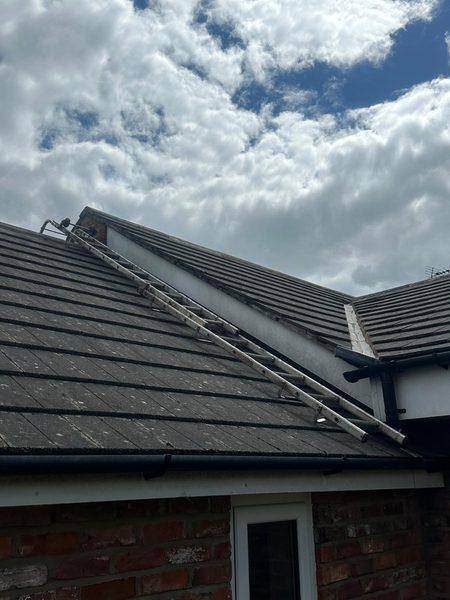
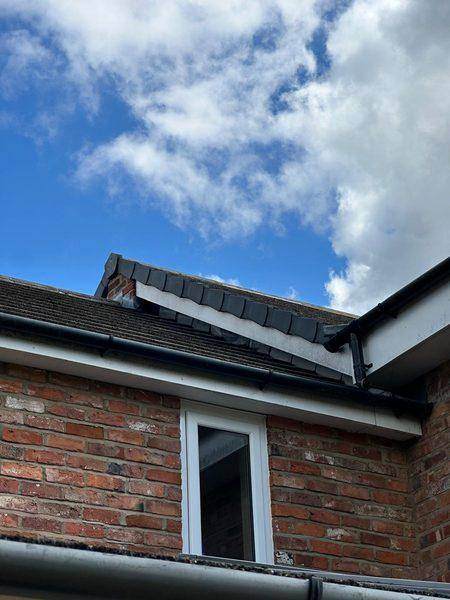
At the top, a separate cap closes the apex where the two runs meet, which is the piece you can see from above in the first photograph with the brickwork of the gable apex showing through beneath it. Both slopes were done in the same trip, working off a roof ladder hooked over the ridge, with the boxes of units kept up on the slope alongside us.
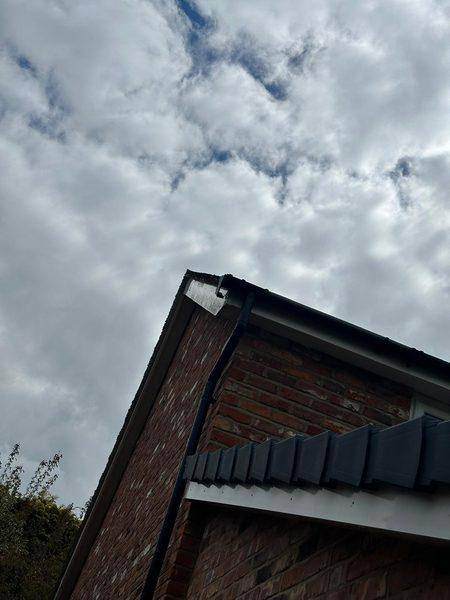
The last two photographs are taken from the garden looking up. The dark grey caps give the gable a clean, unbroken line against the sky, stepping down the pitch above the white bargeboard and fascia, with the black downpipe running away down the brickwork. Grey against white reads better here than a cement fillet ever did, and it will not go patchy the way mortar does as it weathers.
There is nothing at that edge now that needs raking out and renewing. The units are ventilated, the tiles under them are held down mechanically, and the finish is the same the length of the run rather than as neat as the last trowelful happened to be.
Mortar verges come up constantly on the estates around the town, usually spotted after a windy night when a strip of cement has landed on the drive. The fix is the same wherever the house is: strip the old pointing off the edge, check the end tiles and the battens they sit on, and cap the run. It often gets done at the same time as the ridge — we did a dry ridge system in Warrington on the same basis.
More of our dry verge fitting in Warrington is worth a look if you want to see the finish on other houses. If there is cement missing along your gable, or an end tile that has started to lift, ask us for a free quote.
Tell us what the roof is doing and roughly where you are. We will come and look, and you get a written price before anything starts.